
Is Clementine Morrigan having a public mental health crisis?
On talking about incest in public

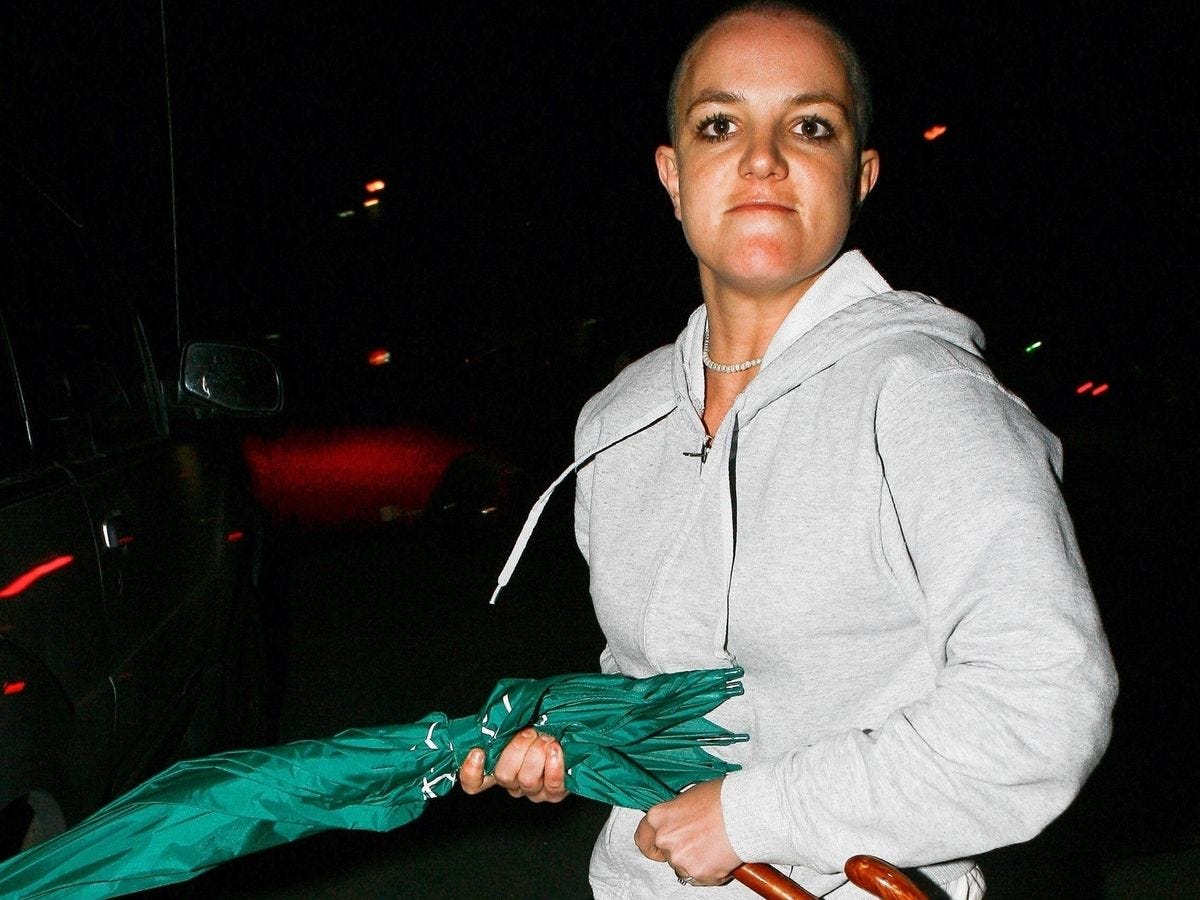
I am no stranger to talking about controversial things on the internet. In fact, it is a big part of my job to say necessary and difficult things out loud, even when people find those things challenging. Anyone is familiar with my work is familiar with being challenged, and familiar with me writing about topics that are difficult to read about.
I have written about incest my entire career. The first writing I ever published about incest was in my very first zine, Glitterduck, published in the year 2000, when I was thirteen years old. Over the last few years, I have started writing in a lot more detail and specificity about what happened to me in my incestuous family, including the sexually abusive behaviours of my father, and the role of my mother in facilitating the abuse and demanding my silence about it. Finally, last summer, I made the decision to publicly name my famous feminist mother, Andrea O’Reilly, and to call on the field of Motherhood Studies to grapple with the reality that one of their most foundational scholars played an active role in demanding her daughters’ submission to and silence about incestuous childhood sexual abuse.
I have been treated as crazy many times in my life. I am the “identified patient” in my family. I am the scapegoat. I am the crazy alcoholic with multiple suicide attempts and psych ward stays under my belt. I am also the cycle breaker: the only member of my family willing to face reality. I am punished, exiled, and called crazy for doing so. I have never shied away from the “crazy” archetype. I insist that “crazy” behaviours are actually very necessary, and wise, survival behaviours. And the force necessary to break cycles of intergenerational incest often requires that you go fucking crazy.
When I was publicly expressing my rage and heartbreak about my mother’s complicity in the sexual abuse I experienced and her repeated attempts to silence me by threatening me and pathologizing me, when I was demanding out loud and in public that the “nice feminists” who built their careers on my mother’s work, listen to my testimony, I was very aware that I appeared crazy to a great many people. It doesn’t matter that I haven’t had a drink since 2012. It doesn’t matter that I run a successful business and have a successful career. It doesn’t matter that I pay my taxes and my bills, that I have figured out how to be an adult despite the severe neglect and trauma my parents and other relatives inflicted on me. None of this matters, because breaking the taboo of speaking about incest is, itself, still coded as crazy.
During this period of public testimony, someone I know online, a fellow incest survivor and a therapist, slid into my DMs. I’m sharing what she said to me, with permission.
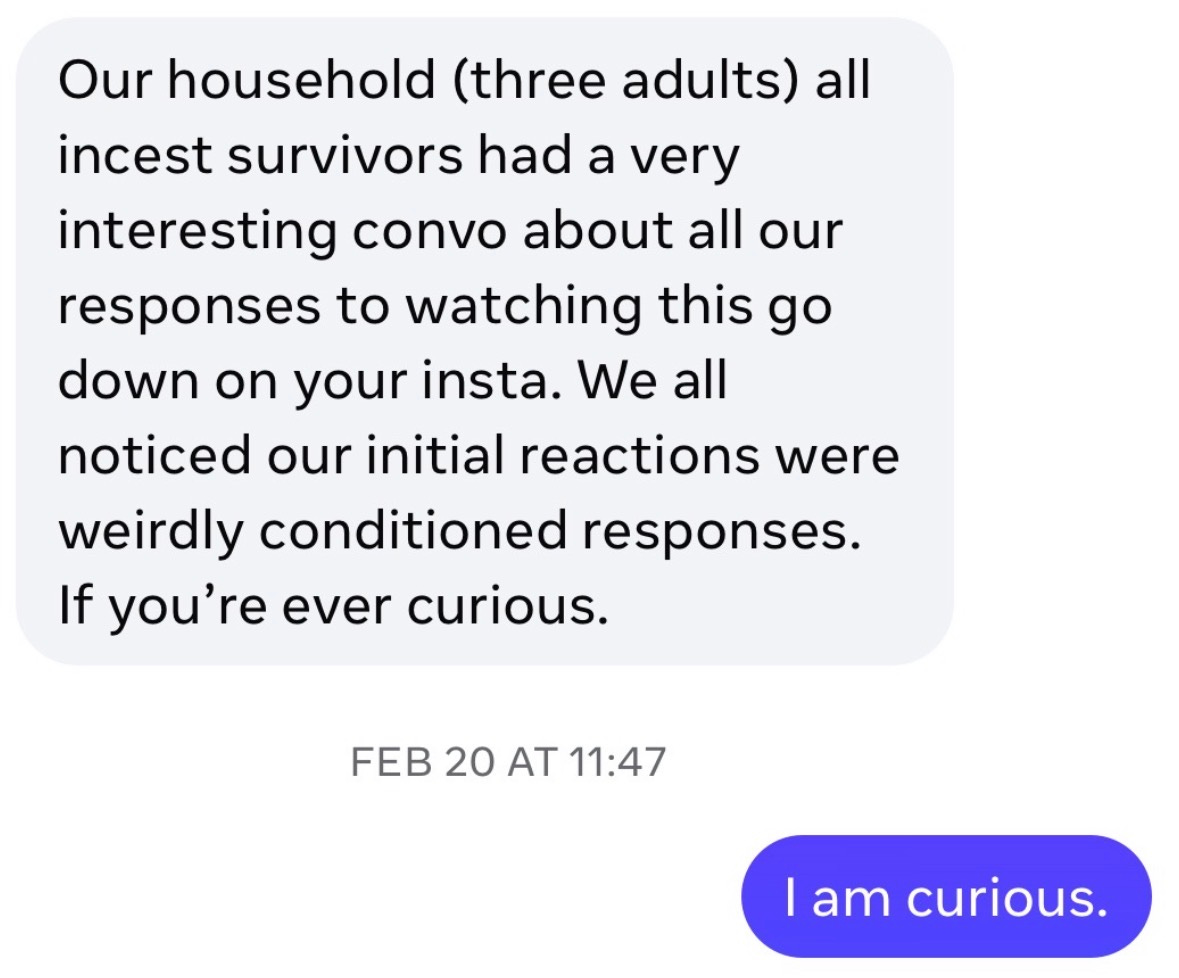
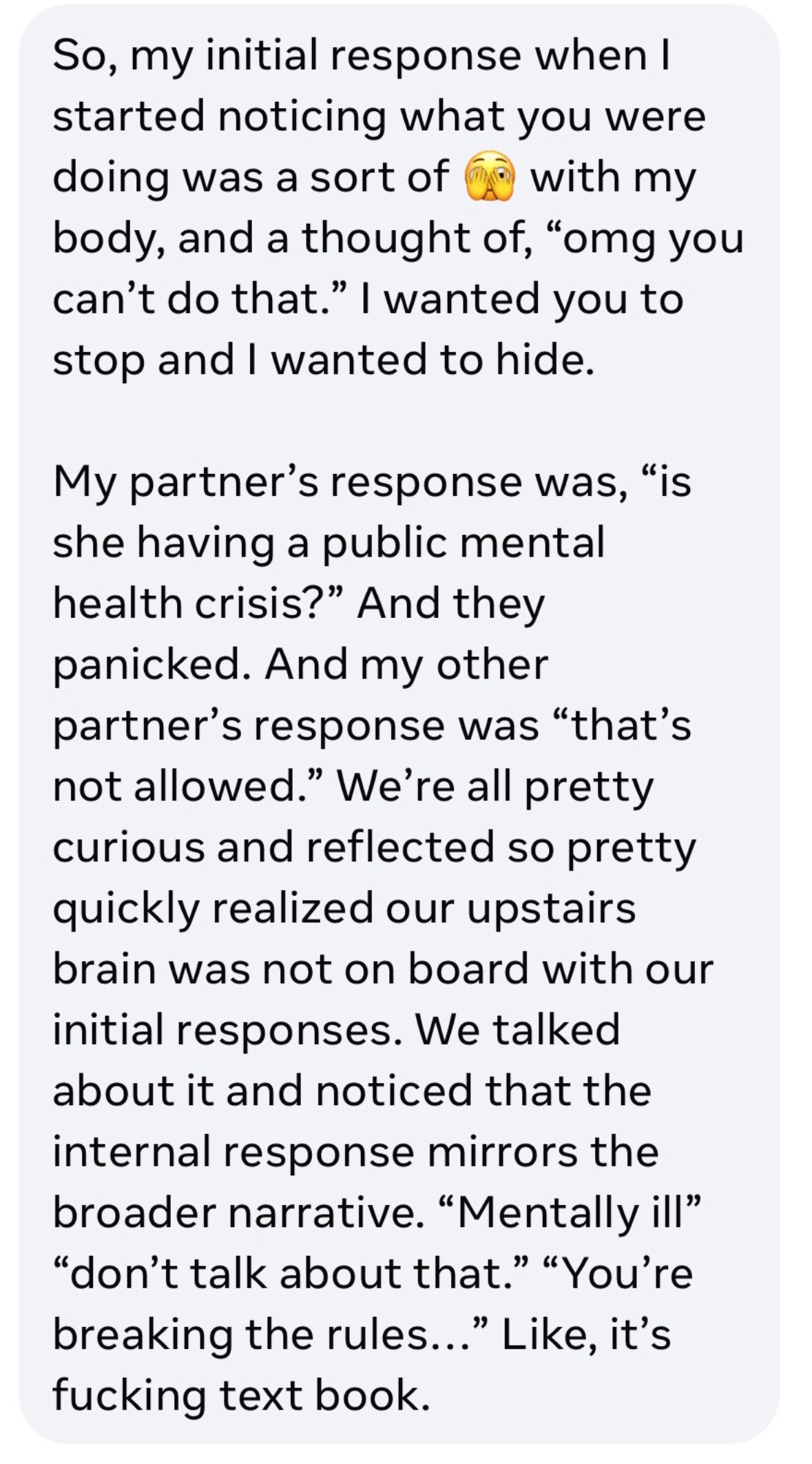
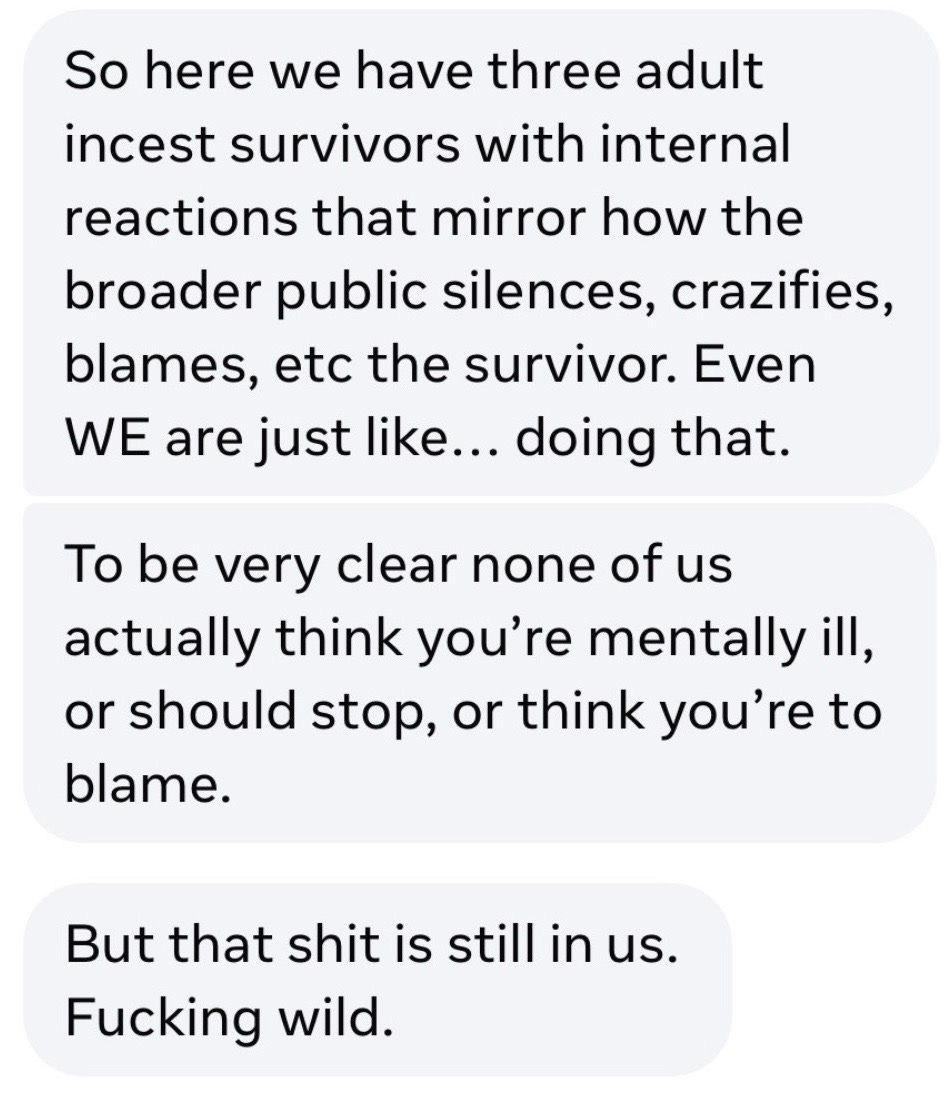
This message was difficult to receive but I still appreciate the honesty. Anyone who has spoken about incest knows what it feels like to receive these responses and to feel these responses hanging in the air even when no one says them out loud. It takes courage to admit when we notice automatic patterns within ourselves that uphold systems we want to see dismantled.
Incest is a family system and a specific form of complex intergenerational trauma. It is requires dissociation within all members of the family and even within the larger culture to carry on without challenge. The automatic reflex to look away, to feel uncomfortable, to feel that the survivor is being “unhinged” or “losing it,” or doing something wrong by telling the truth about what happened to her, is part of how incest works. We are more uncomfortable receiving testimony about incest than we are about knowing that incest is really happening.
While I appreciated the honesty of this DM, it also made me feel so fucking lonely. It is so fucking lonely to do this work in public. It is so fucking lonely to know that so many people feel a reflex to join my mother in silencing me, that so many people would honestly rather I don’t talk about the chronic abuse that literally damaged my brain and body in severe and ongoing ways, robbing me of so many of the simple joys of being human. It is so difficult to feel the entire field of Motherhood Studies rally around my mother by dismissing my testimony as “personal issues” while even my supporters feel physically uncomfortable about what I am doing. It is more stigmatized in our culture to be an incest survivor than an incest perpetrator.
Recently, I was a headliner for a literary open mic. I wanted to read stuff I’ve been working on recently and most of what I am working on recently is about incest. I am very aware of the extremely intense feeling in the room when I choose to read stuff about incest. After going through several pieces, I decided on pieces that only lightly touched on incest. Since the audience was not just “my fans,” I wanted to be sensitive to the fact that not everyone was expecting such intense subject matter.
Right before I was to go up and read, a guy got up to read a piece for the open mic. He read an absurdist short story in which a brother and a sister have a sexual relationship. The story was presented as “funny,” “shocking,” and “bizarre.” It explicitly described incest between teenaged siblings, presenting it as “consensual,” while providing no analysis and demonstrating no awareness of the reality that incest between siblings happens as the result of sexual abuse perpetrated by adults. I felt like I was going to throw up and had to go to the bathroom to cover my ears until it was over. I could hear the laughter of the crowd.
Incest is everywhere in pornography. In fact, if you try to find resources about incest online you will inevitably find pornography. Incest frequently appears in art and literature as “consensual”: adult daughters dating their fathers, siblings having sexual relationships. These works are sometimes funny and absurdist, sometimes shocking and edgy. They never have any understanding or analysis about what incest actually is: a very specific form of intergenerational trauma, dissociation, and child sexual abuse. These stories, which describe incest in detail yet remove it from its political context and erase the reality that incest is ALWAYS traumatic, are far more welcome in public spaces than actual testimony or political theory about incest.
I can’t tell you the number of times people have joked to me or said to me in passing that the queer community, or some other enmeshed group, is “incestuous.” It always makes me want to throw up. We need to culturally resist the use of “incest” as a symbol for anything other than incest itself. Testimony about actual incest is still way too silenced and taboo for us to allow people to inaccurately throw around the word “incestuous.” I promise you that the queer community is not incestuous.
In order for us to abolish incest — and that is the goal — we must be able to talk about incest in public, whenever it is relevant, and we must be able to talk about incest politically. We need to face the impulse inside ourselves to treat incest survivors as crazy. We need to notice the way that the system of incest tries to make us all complicit in its perpetuation, including those of us who are, ourselves, incest survivors. We need to stop protecting ourselves from the reality of incest, especially those of us who are not incest survivors. Being uncomfortable hearing about incest is the same as being uncomfortable hearing about racism, gendered violence, war, genocide, or animal agriculture. We don’t actually have the right to look away and protect our own feelings at the expense of the victims of these crimes.
If you are not an incest survivor, I invite you to speak about incest with the people in your life. You actually don’t need to know a survivor personally in order to care about the sexual abuse of children (and, I promise you, you do know a survivor, probably more than one). I call upon you to talk about incest politically, to discuss it in your political circles, to read political theory on the subject the way you do about any other political issue. I encourage you to see survivors who share our testimony as doing important political work, not having a mental breakdown. Because that is what we are doing. Speaking about incest is always a political act. We are not fucking crazy. What is crazy is that we were sexually abused by our family members.
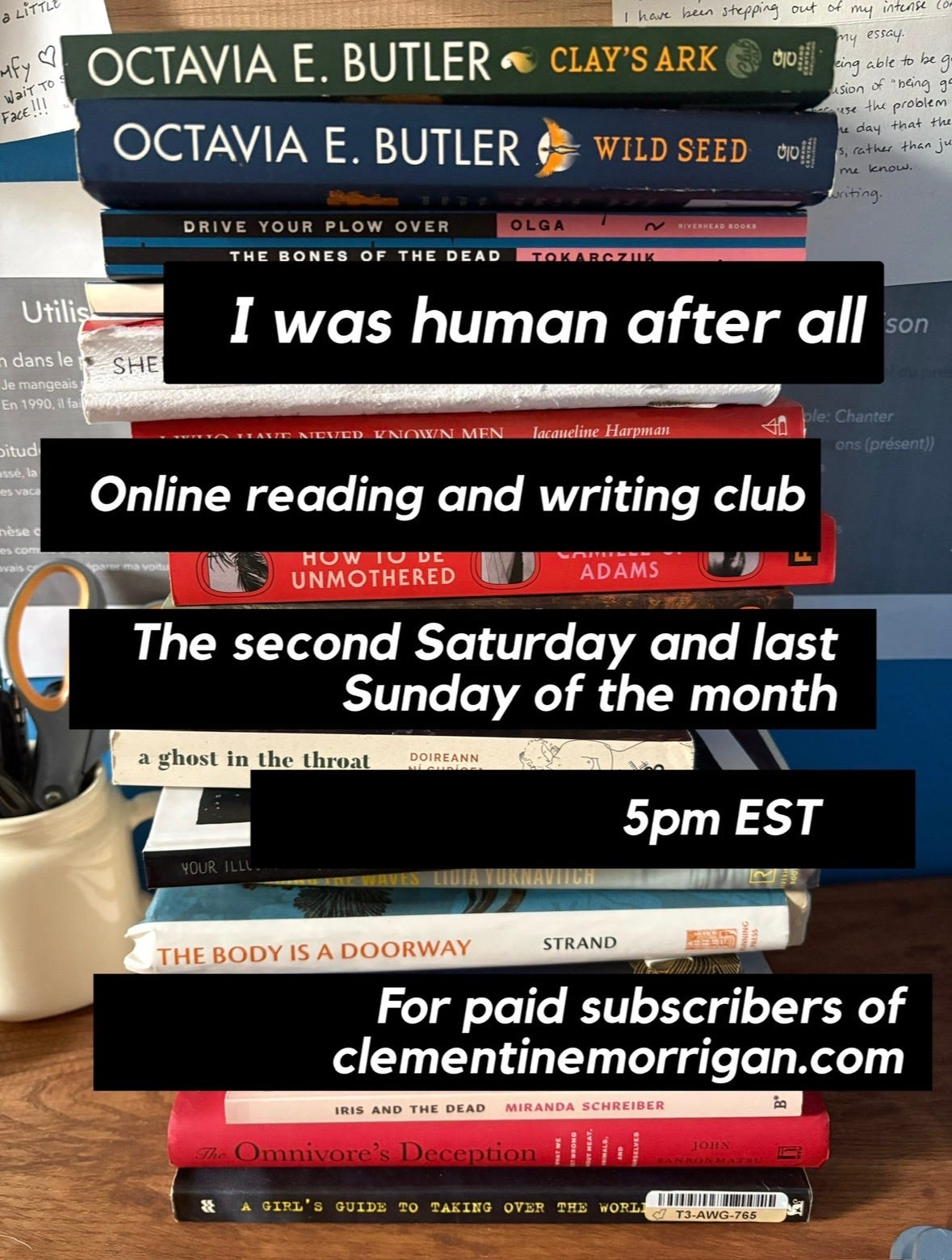
This substack hosts two monthly zoom meetings for paid subscribers! On the second Saturday of the month at 5pm EST we will have a writing group with writing prompts, time for writing, and the opportunity to share your writing. On the last Sunday of the month at 5pm EST we will have a book club where we will discuss a mix of memoirs and weird fiction (and maybe sometimes other stuff). There is also a telegram group where you can chat with other participants, discuss books, and share writing. All the groups are drop in / optional. You can come to just the book club, just the writing club, or a mix of both. Meeting aren’t recorded because I want people to feel free to share openly.
April 11th, 5pm EST, Writing Club:
Just bring yourself and something to write with.
April 26th, 5pm EST, Reading Club:
This month’s book is Wild Seed by Octavia Butler.
Find the zoom links and telegram chat here.
A classic cancel culture episode. Clementine and Jay are joined by conflict mediator and zinester Juno Aventurine to talk about the relationship between trauma and cancel culture, the shadowiest of shadow parts, and the moral ambiguity of the human animal. We also talk about the stubborn spectre of identitarianism and the trials and tribulations of exiting social justice world. Listen to the episode here.
Order my new book, Fucking Magic, here.
Order my new book, L’art oublié de baiser, here.
Pre-order my forthcoming book, Love Without Emergency, here.
Order my zines and books here (shipping is currently open).
Read my secret online diary here.
What I’m reading lately:
Mina’s Matchbox by Yoko Ogawa
Bluets by Maggie Nelson
Will and Testament by Vigdis Hjorth
Tender Points by Amy Berkowitz
Drive Your Plow Over the Bones of the Dead by Olga Tokarczuk
Sad Tiger by Neige Sinno
Moi aussi je voulais l’emporter par Julie Delporte
A Hymn to Life by Gisele Pelicot
The Good People Will Destroy Us by Juno Aventurine
Healing the Fragmented Selves of Trauma Survivors by Janina Fisher
Clementine Morrigan is an underground writer, cultural change maker, moral philosopher, and brazen truth teller. She is the author of numerous zines and books, including the cult classic zine Love Without Emergency, which will be released as a book with Microcosm Press in 2027. Her popular zine series Fucking Magic was released as a book with Revolutionaries Press in 2025. She co-hosts the podcast Fucking Cancelled with Jay Lesoleil. Her work is known for its unflinching engagement with taboo and difficult topics. She works for a world where the dignity of all beings is recognized and protected.
I was so sad to hear how lonely this work is for you. Your writing has an incredible impact. I have incorporated your teaching into my work as a clinical psychologist and frequently refer to it with supervisees and clients who I would have never be able to know are incest survivors without reading you. The number of cases other clinicians bring to me where I have to point out that something is incest is so shocking. I’m so grateful for your writing - it has single-handedly (more than my actual clinical training, supervision, personal therapy or any other professional development I’ve done) made me a therapist who can acknowledge the reality of incest in people’s lives and histories and share with others about how horrifyingly endemic it is. 🙏🏼🙏🏼🙏🏼
I'm dealing with a professional situation where I will have to make a public statement about some unethical shit that's happening in the field, and last week I thought "if no one else than me cares about this, I must be wrong and should just shut up". And then I was like no, this is a commitment to truth. I cannot silence truth. And you were definitely someone on my mind when I thought about the hard commitment to truth. The fact that you don't give up helps me not give up on truth either. Just so you remember the importance of your work. PS Moi aussi je voulais l'emporter is such an important book to me ❤️