
The fight response and the scapegoat
The other goat is sacrificed

Order my new book, Fucking Magic, here.
Order my new book, L’art oublié de baiser, here.
Pre-order my forthcoming book, Love Without Emergency, here.
Read my secret online diary here.
When I was 24 and recently out of an extremely violent abusive relationship that ended with stalking and police involvement, I started calling the Toronto Rape Crisis Centre a lot. Not only was there the trauma from this recent relationship, but there was all the other trauma I had no idea how to deal with: my incestuous sexually abusive family, and the many physical and sexual assaults I experienced as a street involved alcoholic. Because I was a psychiatric survivor, I was terrified of being locked up again, and I had no idea how to access the help I clearly needed. Things were at a rock bottom and I didn’t know what to do. Calling the Toronto Rape Crisis line was my only recourse but it wasn’t enough.
One day I searched the Toronto Rape Crisis Centre on Google Maps and rode my bicycle there. It was in a weird and difficult-to-bike part of Toronto filled with overpasses. I got off my bike at the building but I couldn’t find a way inside. I called them on the phone to announce that I was here and I needed help. They told me the address was just their offices. They didn’t actually provide in person services. I started screaming at the woman on the phone, telling her that I was outside and I needed help. She got me to calm down enough to explain my situation to her. She gave me another address: The Barbra Schlifer Clinic, an organization offering services for domestic violence survivors. She told me to bike there and tell them the Toronto Rape Crisis Centre sent me. I did exactly that.
I was able to access free, non-psychiatric therapy at the Barbra Schlifer Clinic. This was the absolute turning point in my life. Within six months of therapy I gave up drinking and started to go to AA. I was finally receiving the help I desperately needed. This changed everything in my life and sent me on a path that took me away from chronic violence and chaos toward the life I have today. It only happened because I was crazy enough to bike to the Toronto Rape Crisis centre and scream at them to fucking help me.
A lot of really bad things have happened to me in my life. Not only do I have the foundations of incestuous childhood sexual abuse, a patriarchal raging father, and a narcissist mother, but I got pretty much all the possible bad outcomes from these traumas: alcoholism, addiction, poverty, chronic violence, psychiatric incarceration, self injury, suicide attempts, chronic pain, chronic illness, and so on. The trauma just kept multiplying and adding up. Then, after dragging myself out of a literal gutter and building some degree of stability for myself, I was cancelled in a spectacular fashion, for no fucking reason, and lost almost all my friends, my community, and my reputation, as well as being subjected to dehumanizing and sometimes violent harassment from strangers, for over 5 years.
It is that drive in me, that energy that caused me to jump on my bicycle, ride to the Toronto Rape Crisis Centre, and demand they help me, that saved my life time and time again. It is the reason I have survived such extreme adversity. It is the reason I have everything good that I have in my life today. It is the reason I am not dead. It is also the reason why I am so chronically hated, exiled, and scapegoated, in my family of origin and in the larger culture. I refuse to lie down and take it. That drive is called the fight response.
Like most people I have multiple survival strategies. My avoidance is the flight response. My chronic dissociation is the freeze response. My conflict avoidance is the fawn response. Because of my structural dissociation, the range of my different strategies is more pronounced than in many other people. But there is no denying that I have a very strong dose of the fight response.
Recently in therapy I was lamenting on my chronic role as the scapegoat, how the way I am treated by the larger culture mirrors exactly the way I am treated in my family of origin. I was saying that if I had just retreated when I was cancelled, hung my head in shame and gone quiet for a few years, the outcomes probably wouldn’t have been so bad. Hardly anyone can remember why I was originally cancelled, and when I tell them it’s hard to believe because it’s so fucking stupid. But I didn’t lie down and disappear. I kept my head up. I insisted that I didn’t do anything wrong, because I didn’t, and that the dehumanizing harassment and social exile I was being subjected to was, in fact, the abusive behaviour. I became an outspoken voice against cancel culture on the left, giving hope and an alternative to suicide to a great many people, and I was permanently branded as a bad guy. Now anyone can say anything about me. It doesn’t need to make sense. There doesn’t need to be any evidence, or even an identifiable accuser. I am banned, blacklisted, and threatened. People hold meetings to discuss whether I can be invited to a party. Scarlet letter on my chest.
Similarly, in my family of origin, being the whistleblower on the abuse and dysfunction makes me the bad guy. Because I will not lie down and accept the sexually abusive behaviour of my father, or the fact that my narcissist mother who allowed me to be sexually abused and threatened to sue me for writing about it is a celebrated scholar of feminist motherhood, because I insist on telling the truth and being in reality, I am permanently branded as the bad guy. I am called a liar, delusional, and mentally ill, on top of the accusations that I’m selfish and ungrateful which I received all throughout my childhood. I am blocked and cut off. I am dehumanized and denied empathy. I am the scapegoat.
I said to my therapist: It’s the same in both cases. I am scapegoated and hated because I won’t lie down and take it. She said: Yes, because you have a fight response.
Her response made me think about how much of a role my fight response has played in shaping outcomes in my life, both in the ways that it very clearly saved my life, and in the ways that it made everything harder by inviting the ire and malice of so many. It also made me realize how little therapeutic resources I have seen for those with a primary fight response. There seem to be endless workshops and instagram posts about melting the freeze response or overcoming the fawn response but there seems to be almost nothing on working with the fight response.
When I got home I duckduckgoed something about working with the fight response. The first thing that came up was a passage from Pete Walker’s book Complex PTSD: From Surviving to Thriving. I remembered reading the passage when I read the book several years ago.
“Unlike the other 4Fs, fight types assess themselves as perfect and project the inner critic’s perfectionistic processes onto others, guaranteeing themselves an endless supply of justifications to rage. Fight types need to see how their condescending, moral-high-ground position alienates others and perpetuates their present time abandonment.”
Rereading this passage I distinctly remember my experience of reading it years ago, and choosing subconsciously to identify away from being a fight type, focusing more on the parts of me that lean toward freeze and fawn strategies. There is no recognition here of what is brilliant, life saving, and necessary in the fight response (all survival responses have aspects that are brilliant, life saving, and necessary). I find the way Walker talks about fight types to be significantly less compassionate and empathetic than the way he talks about other types. He also calls the fight type “the narcissistic defence” conflating all fight types with narcissism, which I don’t think is accurate. I am not a narcissist. I definitely don’t, and never have, assessed myself as perfect (and to be honest, I don’t think narcissists assess themselves as perfect either. The underlying emotional experience of narcissism is shame).
Fight types are the most likely to experience scapegoating and rejection by their families and by society. Fight types are also the most likely to have the drive and willingness to face adversity head on, making their own recovery and a collective reckoning with abuse and dysfunction more likely. Fight types change things and make things happen. Fight types refuse to submit. Like all survival strategies, the fight response can be expressed in functional and dysfunctional ways, but the fight response is not inherently dysfunctional or narcissistic. And the “present time abandonment” that fight types experience is not necessarily a result of their own dysfunctional behaviour. Sometimes it is the result of their refusal to accept the dysfunctional behaviour of others.
Fight types, like all survival strategies, deserve resources to help us lean into our strengths, avoid dysfunctional expressions of the strategy, and, in the case of fight types in particular, deal with the rejecting responses of families and societies who do not want to deal with whistleblowers. The shaming and scapegoating of the fight response can lead to fragmentation, both culturally and in our individual psyches. Learning how to face threat and injustice head on is a healthy skill set that benefits everyone and does not have to be dysfunctional. When wielded with skill, the fight response is a powerful force of transformation in the world. Women in particular would benefit from learning to strengthen the fight response. Gabor Maté notes in The Myth of Normal that women make up 80% of the population who suffer from autoimmune disorders (I fall among them) and that outcomes for autoimmunity improve when skills for assertiveness are developed.
I also think we need to look at the connection between the scapegoat and the fight response. In dysfunctional family systems, the scapegoat is the family member who begins to name and resist the family dysfunction. This usually takes the form of the fight response. The scapegoat begins to resist, to act out, to get angry. The scapegoat is the one who will not submit, who will not act like things are fine when they are not fine. The scapegoat is then treated as the problem. As Dorothée Dussy points out — families would rather have a crazy liar in the family than an incest perpetrator in the family. This dynamic plays out in all dysfunctional families, not just incestuous ones. The scapegoat is the whistleblower. She becomes the scapegoat when the family chooses to blame and reject her for telling the truth.
I was recently looking into the origins of the scapegoat concept. I came across this on Wikipedia: “A scapegoat is one of a pair of goats used in the Yom Kippur Temple service during the era of the Temple in Jerusalem. The scapegoat had a band of red wool placed on it, and was then released into the wilderness, taking with it all the sins and impurities of the people as an act of symbolic atonement. The other goat was sacrificed.” I was deeply affected reading this passage. I had no idea that the scapegoat is one of a pair of two goats. The scapegoat is blamed and exiled. The other goat is sacrificed. This maps onto the dynamics in dysfunctional families and cultures exactly. While it can feel like there is no worse outcome than the dehumanizing blame and exile of the scapegoat experience, it is in fact better than the alternative. The bad sister is rejected and blamed, but the good sister is sacrificed. The whistleblower is exiled, but the one who complies must surrender their autonomy and authenticity.
I love my fight response. I am not exaggerating when I say it saved my life. And while the path of standing up for myself has proven to be an extremely difficult one, I would not trade this timeline for the one where I laid down and took it, in any chapter of my life. While being cancelled has been brutal beyond comprehension, I grew so much in my strength, authenticity, and power by refusing to submit. While being rejected by my family of origin has been brutal beyond comprehension, I grew so much in my strength, authenticity, and power by refusing to submit. My ability to express my fight response appropriately has definitely grown as I have grown in my recovery but I do not think my screaming at the Toronto Rape Crisis Centre volunteer was the wrong move. Anyone who works with traumatized populations needs to be able to handle a fight response directed at them.
So much advice about survival strategies seems to be about leaning into the opposite. So fawn types should learn to be more assertive and fight types should learn to be less angry. And this type of advice can definitely be useful sometimes. But I actually think that my fight response, healthy though it is, has barely scratched the surface of my reservoir of rage. And this is not dysfunctional or inappropriate rage. The rage I have buried inside me, enormous as it is, is the exact right proportion to the violence, violation, and humiliation that I have been made to endure, and to the brazen cruelty, domination, and destruction of the most sacred happening everywhere in the world. It is not that I need to be less angry, but that I need teachers and guides for how to relate to, express, and use this anger is healthy, helpful, and functional ways.
I would not be where I am without my fight response. I have many other survival strategies but it is my fight response that gives me the power and energy I need to make change. My stubborn refusal to lie down, my perseverance in the face of enormous adversity, these are the qualities that have allowed me to overcome seemingly insurmountable obstacles. For those of us facing the daunting task of recovering from complex trauma, channeling the power of the fight response can be necessary and life saving. It can be the make or break ingredient because it can give us the power and momentum needed to overcome. I do not need to learn to let go of or move away from my fight response. What I need is to learn how to take care of myself, how to rest and recuperate, after expending enormous energy fighting seemingly impossible battles. What I need is gentleness and kindness, a place to rest — things very rarely offered to the scapegoated fight types.
The next book club meeting will be February 22nd at 5pm EST. We will be discussing Drive Your Plow Over the Bones of the Dead by Olga Tokarczuk.
And… big announcement! The book club is branching out to include a monthly writing club! All sessions are drop in / optional. You can come to just the book club, just the writing club, or a mix of both. There is a telegram chat to keep in touch with participants, discuss books, and share writing. Come be nerdy with us.
Since I don’t want to clog your feed by posting every time there is a meeting, I am asking that you add the dates to your calendar, and come to this page to find the zoom links. You can find a permanent link to the reading and writing club in the navigation bar above. I will post reminders of the dates when I publish essays.
The first writing club meeting is February 14th at 5pm EST.
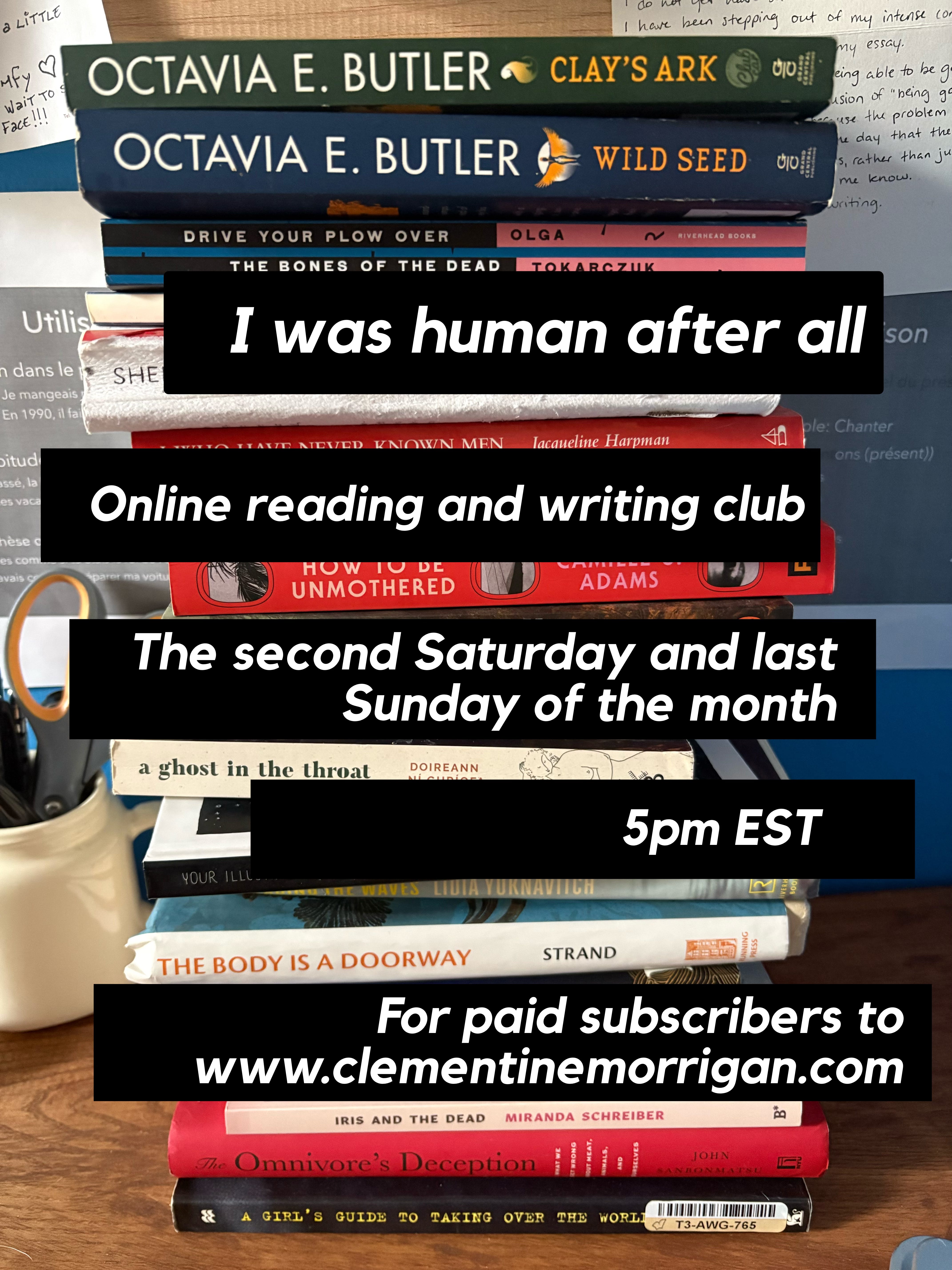
What I’m reading lately:
I’m Glad My Mom Died by Jennette McCurdy
Never Whistle at Night: An Indigenous Dark Fiction Anthology edited by Shane Hawk and Theodore C. Van Alst Jr.
Pathemata, Or, The Story of My Mouth by Maggie Nelson
Something Bright, Then Holes: Poems by Maggie Nelson
Pieces You’ll Never Get Back: A Memoir of Unlikely Survival by Samina Ali

Clementine Morrigan is an underground writer, cultural change maker, moral philosopher, and brazen truth teller. She is the author of numerous zines and books, including the cult classic zine Love Without Emergency, which will be released as a book with Microcosm Press in 2027. Her popular zine series Fucking Magic was released as a book with Revolutionaries Press in 2025. She co-hosts the podcast Fucking Cancelled with Jay Lesoleil. Her work is known for its unflinching engagement with taboo and difficult topics. She works for a world where the dignity of all beings is recognized and protected.
So important. It reminds me of a piece of another essay of yours where you say that while there's so much focus right now on slower, down-regulating, delicate methods, having a big impactful experience can also be helpful to some people. Maybe those more plunging experiences wake up the fight response, allowing to get out of freeze or collapse.
Kimberly Ann Johnson works a lot with activating the fight response in women. She's giving a "Mobilize freeze" course this month, but her way of thawing is accessing fight. Her signature work is called "activate your inner jaguar", it's also about accessing fight and the predator (as a jaguar) energy. Haven't been able to take it yet but I admire her work a lot.
But yeah, we definitely need more healthy, helpful, and functional ways to feel and express anger. It's so important yet so difficult to express it.
I needed to hear this! It all resonates and I know it deeply to be true :') In spite of the pain, I laughed out loud when you said the rage you've shown barely scratches the surface of what's inside.
I heard a "upper middle class" girl once say confidently that anyone who yells first in an argument is surely "the one who's wrong." What a flattening of emotion, power, and morality -- all at once!
PS: The next book club happens on my birthday :) ❤️